Early Renaissance Art
 |
|
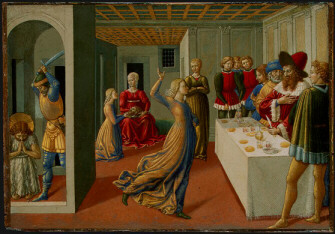
The Feast of Herod
and Beheading of St. John the
Baptist
ca. 1462,
by Benozzo Gozzoli
tempera on panel
Samual H. Kress Collection
|
|
Click here
to see our
gift shop.
|
The Early Renaissance time period in art falls
between the end of the Middle Ages and the beginning of the
High Renaissance. Early Renaissance art first developed in the
city of Florence in Central Italy in the fourteenth century.
Planting seeds of the Early Renaissance were
prominent Trecento
literary figures, the humanist poets Dante and Petrarch.
Petrarch believed that the culture of the Roman Empire was the
apex of human achievement, and Dante's contribution was his
Divine Comedy, offering a final reconciliation
between Aristotelian philosophy and Christianity. The
Early Renaissance melding of philosophy and Christian
thought would be beautifully illustrated during the
High Renaissance
by Raphael Sanzio
in the Vatican's Stanza della Segnatura.
Early Renaissance painting, sculpture, and literature in
Italy were also influenced by an influx of scholars who
migrated to Rome following the fall of Constantinople in
1453. The arrival of these scholars generated new interest in
ancient Greek and Roman learning with a
re-examination of ancient Greek and Roman texts. This
humanist
learning and study of the antique was reflected in Early
Renaissance art in painting, sculpture and literature. Early
Renaissance artists of the 15th century began once again to
study nature to gain an understanding of concepts like
perspective and anatomy, knowledge lost since antiquity. The
stylized works of Byzantine artists was replaced in the Early
Renaissance by a return to naturalism. These extraordinary
achievements were reflected in the art and architecture of
the Early Renaissance.
Prominent Early Renaissance artists were people such as
Masaccio, Donatello, Piero della Francesca,
Perugino, Verrocchio, and Botticelli
Brenda Harness, Art Historian
For more information on Italian Renaissance
Art and book recommendations, click
here.
- Missing Fra Angelico Paintings Found Behind a Door
Imagine the surprise of art experts when two long missing Fra Angelico paintings were found in November, 2006 behind a door in an apartment in Oxford, England.
- The Dome of Florence Cathedral by Brunelleschi
The dome of Florence Cathedral by Brunelleschi is commonly known simply as The Duomo because of the beauty and magnificence of its design and its striking impact on the skyline of Florence.
- Masaccio
Italian Renaissance Painter, Masaccio, made huge steps in the art of painting, innovations not seen since antiquity.
- Lorenzo Ghiberti's Gates of Paradise
Michelangelo aptly named Lorenzo Ghiberti's Gates of Paradise acknowledging the stunning work of the older artist, who transitioned art from the Gothic style into the Renaissance style.
- Donatello
Italian Renaissance artist Donatello was a skilled artisan in both marble and bronze, but it is said that he demanded a certain amount of artistic freedom.
- Domenico Ghirlandaio
Domenico Ghirlandaio was a popular painter of the Italian Renaissance, but his main claim to fame was his pupil Michelangelo Buonarroti.
- Luca della Robbia | Italian Renaissance Workshop Secrets
The family workshop members took the technical formula developed by their founder Luca della Robbia to the grave.
- Paolo Uccello, Obsessed With Perspective
Early Italian Renaissance artist Paolo Uccello joined the ranks of groundbreakers like Brunelleschi, Masaccio, and Ghiberti in his exploration of the new device of perspective.
- Piero della Francesca
History records nothing for centuries of Italian Renaissance master Piero della Francesca (1416-1492) until his re-discovery in the 20th century.
- Andrea del Castagno | A Painter of Some Influence
Andrea del Castagno was acclaimed for his frescoed portrait series of Famous Man and Women during the Italian Renaissance.
- Fra Filippo Lippi, The Reluctant Friar
Raised in a Carmelite friary, Fra Filippo Lippi was anything but pious when he eloped with one of the nuns who bore him two children.
- Antonio Pollaiuolo | Dissecting Corpses for Art
Intensely interested in the movement of the human body, Antonio Pollaiuolo is thought to have dissected corpses to improve his understanding of human anatomy.
- Andrea Mantegna - Leading the Way
Andrea Mantegna paved the way for later artists of the Italian Renaissance and Baroque eras through his illusionistic style and dramatic foreshortening.
- Melozzo da Forli | Master of Foreshortening
Forgotten for several hundred years, Italian Renaissance painter Melozza da Forli has regained his popularity. Although his frescoes survive only in fragmentary form now in the Quirinal Palace in the Vatican, his fame was well deserved as the inventor of sotto in su or extreme foreshortening.
- Perugino
Perugino was born in Perugia, Umbria, but like other artists of the time, he gravitated to Florence in the mid-1470's drawn by the artistic climate.
- Verrocchio
Andrea del Verrocchio (1435-1488) was an Italian Renaissance artist working in the Florentine court of famous art patrons, Lorenzo and Giuliano de Medici.
- The Life and Work of Sandro Botticelli
The life and work of Sandro Botticelli were seldom mentioned for several centuries following the end of the Italian Renaissance.
|
 QUOTE
QUOTE