|
||||||
Andrea del Castagno | A Painter of Some Influence
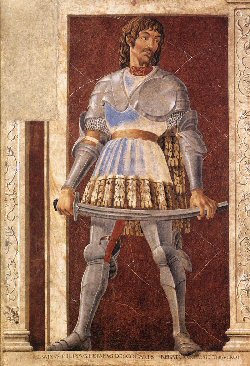
Andrea del Castagno was well-known for his portrait series of Famous Men and WomenCastagno's work shows his interest in scientific perspective. Not only was he influenced by Masaccio but also by Domenico Veneziano in his use of light colors. He was widely acclaimed, however, for his series of Famous Men and Women produced for the Villa Carducci Pandalfini at Legnaia. The Florentine condottiere Pippo Spano was portrayed by Andrea del Castagno in 1450 as an idealized heroic military commander with his relaxed pose, at ease with feet placed wide apart. In this over-life-size series, Castagno executed figures with the illusion of body movement and expressive facial rendering. He heightened the naturalism by presenting the figures as standing in illusionistic architectural niches. Castagno's emotional portrayal of the young David painted on a shield is similarly realistic and expressive, owing thanks to the influence of Donatello. Giorgio Vasari praised Castagno for his excellent draughtsmanship. The Opera del Duomo commissioned Castagno to execute a fresco, an equestrian portrait of Niccolò da Tolentino in 1456, and this was Castagno's final work. Castagno's work was influential for later generations of Paduan and Florentine painters. Brenda Harness, Art Historian | ||||||
|
 QUOTE
QUOTE
|
Welcome ! |
|
We respect your privacy and will never sell your personal information. |
| Click here to sign up for our newsletter. |
Buy great
art books
at Amazon!
Home Glossary of Terms Contact Us About Us Newsletter Subscription