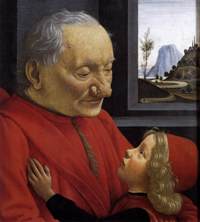
Those little is known of Early Renaissance painter Domenico Ghirlandaio (1449-1494), it is believed that the young Florentine derives his name from his father’s talent for making garlands in his goldsmithing shop. Ghirlandaio’s earliest works date from the early 1470s, influenced significantly by Andrea Castagno‘s frescoes. Vasari credits Alesso Baldovinetti as Ghirlandaio’s earliest teacher, but this appears to be inaccurate due to similarity in age between the two artists.
Known as a painter of fine detail, Ghirlandaio’s style seems to be based on casual observation and anecdote, somewhat stiff in rendering unlike that of his contemporary Botticelli whose style is more lush and lyrical. Influenced by the symmetrical style of Fra Filippo Lippi, Ghirlandaio later ran a large workshop and earned important commissions like the two frescoes in the Collegiata at San Gimiganano near Florence of the life of St. Fina executed in 1475.
Ghirlandaio was particularly fascinated by the rendering of portrait heads, and they show up often in his large scale compositions. One such composition of ca. 1482 was commissioned for the Vatican’s Sistine Chapel depicting the calling of the first Apostles, Andrew and Peter, and is peopled by prominent Florentine citizens living in Rome. This work may be politically related to the Pazzi conspiracy of Medici fame.
Like Donatello, Ghirlandaio apparently studied antique Roman imagery while in Rome because its elements often show up in his workshop compositions. In the 1480s, Ghirlandaio’s workshop executed two fresco cycles and a tempera altarpiece for two Medici bankers, Francesco Sassetti (fresco scenes from the life of St. Francis of Assisi) and Giovanni Tornabuoni (fresco scenes from the life of St. John and the Virgin).
The Tornabuoni commission was probably completed by the workshop including a young Michelangelo after Ghirlandaio’s death is 1494. While Ghirlandaio himself never received a major Medici commission, he was still considered a significant painter of the Early Renaissance. His son Ridolfo was also considered a notable painter. His other pupils included Francesco Granacci and Giuliano Bugiardini.
Brenda Harness, Art Historian