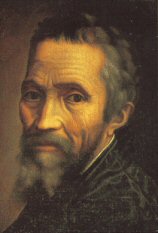
Michelangelo di Lodovico Buonarroti Simoni (1475-1564), known simply as Michelangelo, was an Italian painter, sculptor, and architect of the High Renaissance period. Much of the information we know about the life of Michelangelo Buonarroti comes from his biographers, Giorgio Vasari (1511-1574) and Ascanio Condivi (1525-1574). Further, Michelangelo Buonarroti wrote a number of letters to Italian Renaissance sculptor, Benvenuto Cellini (1500-1574). The life of Michelangelo was long, allowing him ample time to produce a prodigious amount of work. He was well-known for his fierce temper and for the terribilita or awe-inspiring quality of his work. The great Italian Renaissance artist was outlived by both of his biographers and Cellini only by about ten years. All three men personally knew Michelangelo Buonarroti.
In his Life of Michelangelo, Vasari heaps profuse praise upon the great master when he describes Michelangelo’s famous sculpture David. “The grace of this figure and the serenity of its pose have never been surpassed, nor have the feet, the hands, and the head, whose harmonious proportions and loveliness are in keeping with the rest. To be sure, anyone who has seen Michelangelo’s David has no need to see anything else by any other sculptor, living or dead.” (Vasari’s Life of Michelangelo, I-339). Michelangelo Buonarroti’s officially authorized biographer, Ascanio Condivi (1525-1574) published his Vita di Michelagnolo [sic.] Buonarroti in 1553. Through Condivi’s Vita, Michelangelo corrected certain “errors” made by Vasari in his Life of Michelangelo, exercising virtually complete literary control over the writings of Condivi.
Brenda Harness, Art Historian
- Michelangelo Buonarroti Timeline Michelangelo Buonarroti Timeline – His Life and Works
- David by Michelangelo, A Symbolic Interpretation The Italian Renaissance sculpture of David by Michelangelo looms over the town square in the city of Florence like a sentinel, larger than life, a symbol of the Florentine Republic.
- The Last Judgment by Michelangelo The Last Judgment by Michelangelo Buonarroti was a fresco commissioned by Pope Clement VII in 1534 for his own private chapel, the Sistine in Rome.
- The Pieta by Michelangelo, A Study of Redemption Through Pain After hearing that his work was credited to someone else, The Pieta by Michelangelo was secretly signed by the artist one night when he entered the Vatican after hours.
- The Medici Tombs of Michelangelo, New Sacristy, San Lorenzo, Florence Michelangelo designed the New Sacristy Chapel of San Lorenzo in Florence to house his sculptural works for the Medici Tombs.