
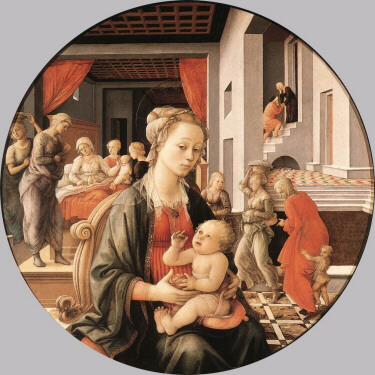
Born Filippo di Tommaso di Lippo, the Florentine painter known to history simply as Fra Filippo Lippi (1406-1469) was raised in a Carmelite friary. Although he took his vows in 1421, Fra Filippo Lippi found himself unsuited to the monastic lifestyle. Fra Filippo Lippi left the friary with a nun whom he later married after engaging in an illicit love affair. Fra Filippo Lippi’s wife bore him two children, one of whom was a son who became a master in his own right, Filippino Lippi.
According to Vasari, Fra Filippo Lippi became interested in painting by observing Masaccio working in the Carmine church. Even prior to leaving the convent in 1432, Fra Filippo Lippi was already known as a talented fresco painter. He enjoyed the support of the Medici family, and such support earned him an important papal commission in 1447 for the Florentine Signoria for his fresco work of St. Bernard’s Vision of the Virgin.
Fra Filippo Lippi’s later painting style is linear, lyrical, and decorative, a product of his own fantastic imagination. Fra Filippo Lippi’s architectural style may be derived through observation of other artists’ works (Luca della Robbia, Donatello) rather than through direct observation of actual architecture. Fra Filippo Lippi was more interested in nature and landscape depiction. Fra Filippo Lippi’s work was lauded by Domenico Veneziano, and he was probably Sandro Botticelli‘s teacher and influential to many other artists of his time. He was also a major influence on the Pre-Raphaelites, an artistic movement of the 19th century.
Brenda Harness, Art Historian