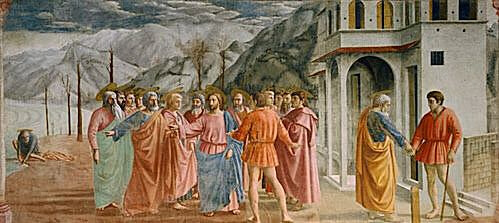
For the first time since antiquity in Western art, we see the use of full perspective in Masaccio’s Tribute Money. Masaccio’s Tribute Money is a fresco series of ca. 1427 in the Brancacci Chapel of the church of Santa Maria della Carmine in Florence.
Masaccio’s Tribute Money depicts a scene from Matthew’s Gospel, that of the arrival of Jesus and the Apostles in Capernaum and a visit from the tax collector. Masaccio’s Tribute Money tells the as three separate events happening at different times: first, the tax collector requests the tribute money to Rome, and Jesus tells Peter how to find it; second, Peter fishes as directed by Jesus and catches a fish in Lake Genezaret, then extracts a coin from the fish; third, Peter pays the tax collector with the coin (tribute money). Contemporaneous to Masaccio’s Tribute Money was a controversy over a proposed tax reform in Florence which was settled in 1427. The Biblical story referenced by Masaccio’s Tribute Money is meant to teach the legitimacy of paying taxes.
Also noteworthy in Masaccio’s Tribute Money is the innovative technique of the use of a single light source in this fresco series. Masaccio’s Tribute Money and Expulsion from Paradise are considered to be Masaccio’s masterpieces.
Masaccio was influrenced by Early Renaissance sculptor Donatello, architect Brunelleschi and by Trecento artist, Giotto. Masaccio strongly influenced High Renaissance artist Michelangelo.
Brenda Harness, Art Historian