While High Renaissance painter Andrea del Sarto (1486-1530) spent most of his life in his home town of Florence, Italy, he probably briefly visited briefly both France to work and Rome to absorb the stylistic achievements of great masters like Raphael, Leonardo, and Michelangelo who had already left Florence. Along with Fra Bartolommeo, Andrea del Sarto became one of the premier painters in his home town. His name ‘del sarto’ comes from the profession of his father who worked as a tailor.
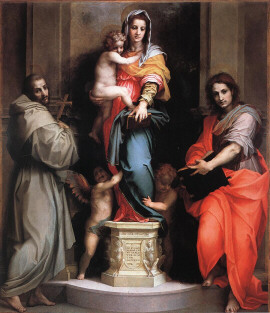
Andrea del Sarto was primarily a fresco painter, and his work is characterized by the relaxed and elegant style of Raphael and Fra Bartolommeo whom he emulated. Del Sarto’s most famous work is his masterpiece of 1517, the altarpiece of the Madonna of the Harpies, now in the Uffizi in Florence. Del Sarto also executed frescoes in the Florentine churches of SS. Annunziata for the Servite religious order, and for the Chiostro dello Scalzo where he created a monochromatic cycle based on the life of Saint John the Baptist.
Andrea del Sarto was a popular artist.
Andrea del Sarto was in popular demand. So much so that in 1519 Francis I of France commanded del Sarto to appear at his court. Francis gave Andrea money and sent him to purchase art in Italy. Del Sarto simply returned to Florence and failed to follow through with his assigned task, instead keeping the money for himself. For the refectory of San Salvi convent near Florence, Andrea del Sarto executed his final major fresco work of the Last Supper (1527).
Most of the information we have about Andrea del Sarto comes from his pupil Giorgio Vasari who describes him in a less than flattering light personally, but lauds his painting as “flawless”. Vasari’s account has been discredited, however. Although a great master in his own right, a superior draughtsman and colorist, Andrea del Sarto was overshadowed by Renaissance giants like Raphael and Michelangelo. Some of his works display a hint of Mannerism, something which is picked up by his famous pupils Pontormo, Rosso Fiorentino, and Cecchino del Salviati.
Brenda Harness, Art Historian