
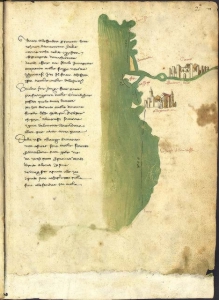
Begun in Florence and written from about his thirty-seventh year until his death, a period of about thirty years, the notebooks of High Renaissance master Leonardo da Vinci consist of about five thousand pages written on loose leaves. Leonardo’s notebooks contain no punctuation, and they document his observations about art and science.
The original pages of da Vinci’s notebooks are now bound and scattered throughout England, Italy and France, separated into separate volumes. Giorgio Vasari tells us that each numbered page of Leonardo da Vinci’s notebooks contains a complete thought. That appears to be his only rule. A famous page that is familiar to us all from his notebooks is Leonardo da Vinci’s drawing of The Vitruvian Man.
Topics in the Italian Renaissance notebooks of Leonardo da Vinci are varied, but they include ideas on fine art painting, perspective, eyesight, light and shade, perspective of disappearance, theory of colors, aerial perspective, proportion and movement of the human figure, botany for painters, elements of landscape painting, art instruction, disposition for the artistic career, artist’s materials, and the history of the art of painting,
Project Guttenberg has a complete e-text translation of Leonardo’s manuscripts translated by that can be accessed through their web site.
Brenda Harness, Art Historian