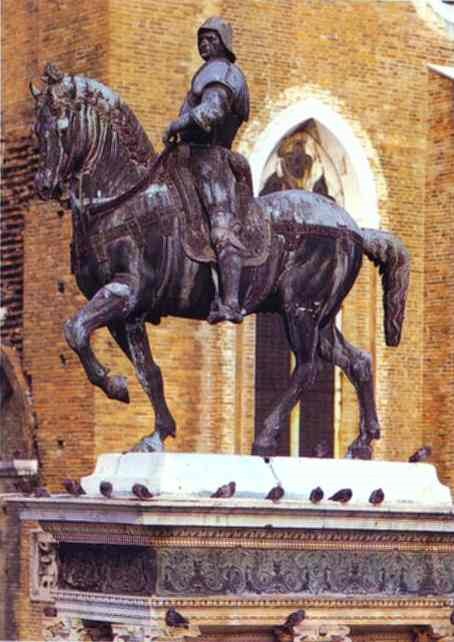
While Leonardo da Vinci surpassed his master Verrocchio in fine art painting as a young man, Verrocchio’s true genius was as a sculptor. In 1479 Verrocchio began work on his famous equestrian sculpture of Venetian condottiere, Bartolommeo Colleoni, known as the Colleoni Monument. Bronze horse sculpture has a long tradition in art, particularly in Italy.
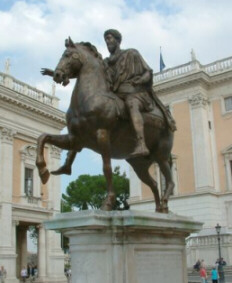
Italian artists like Verrocchio and Leonardo would surely have seen the monumental bronze horse sculpture of the Roman Emperor, Marcus Aurelius, in the heart of Rome, the centerpiece of St. Peter’s piazza. This equestrian sculpture and the equestrian sculpture of Colleoni surely later inspired Leonardo to propose the construction of a 24-foot high, bronze horse sculpture for Ludovico Sforza, Duke of Milan in 1483. In preparation for casting Leonardo’s Great Bronze Horse sculpture, the artist constructed a full-scale clay model which was destroyed by war.
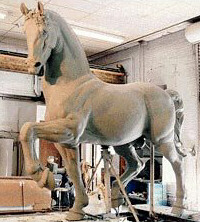
Five hundred years after Leonardo da Vinci’s death, Leonardo’s 24-foot Great Bronze Horse sculpture has finally been cast thanks to the efforts of da Vinci admirer, Charlie Dent. Dent studied Leonardo da Vinci’s notebook and drawings in this effort. He asserts that this effort was a “gesture of appreciation from the American people for all that the Renaissance has meant to our own culture.” Italian Renaissance art history owes a great debt of thanks to Charlie Dent for finally executing Leonardo’s famous Great Bronze Horse sculpture.
Brenda Harness, Art Historian