
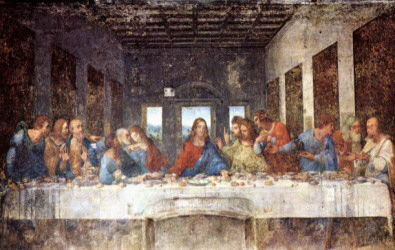
Da Vinci’s Last Supper painting of 1498 is not a traditional true fresco (buon fresco) painted on wet plaster, rather it is painted on dry plaster with tempera in the fresco secco technique. Da Vinci’s Last Supper painting can be found in the refectory (dining hall) of the convent of Santa Maria della Grazie in Milan, Italy. The stone wall was first prepared for Da Vinci’s Last Supper painting by sealing the stone with pitch, mastic, and gesso. Da Vinci’s experimental technique caused rapid deterioration of the Last Supper painting, as it was described by Vasari, a Leonardo biographer, as being “ruined” by 1556. The dry paint of Da Vinci’s Last Supper painting was reported to already be flaking off as early as 1517, a consequence of his experimental technique. Da Vinci’s Last Supper painting has undergone a number of restorations, the first in 1726, and the last in 1999 which took 21 years to finish.
Brenda Harness, Art Historian